top of page


Workshop on AI in Weather and Climate Science
On 7 Oct. 2026, this workshop brought together researchers at the intersection of machine learning, atmospheric and climate research, and applications in energy to exchange on recent advances in the field. Machine learning is rapidly transforming atmospheric and climate science and energy applications. The topics of the workshop included but were not limited to explainability, climate modelling, weather forecasting, and nowcasting applications. Go here for a look at the progr
Oct 9

Predicting Urban Heat Hotspots at Neighbourhood Scale
Our new study on Spatiotemporal Downscaling and Nowcasting of Urban Land Surface Temperatures With Deep Neural Networks is published now. Our urban downscaling model provides high-resolution (1 km, 15 minutes) land surface temperatures across European cities and forecasts their development over the next hours. This is particularly relevant during urban heatwaves as in summer 2026. This research was led by Solomiia Kurchaba from Energy Weather & AI Lab. Satellite-derived land
Sep 1
Forecasting how weather impacts the national solar power production
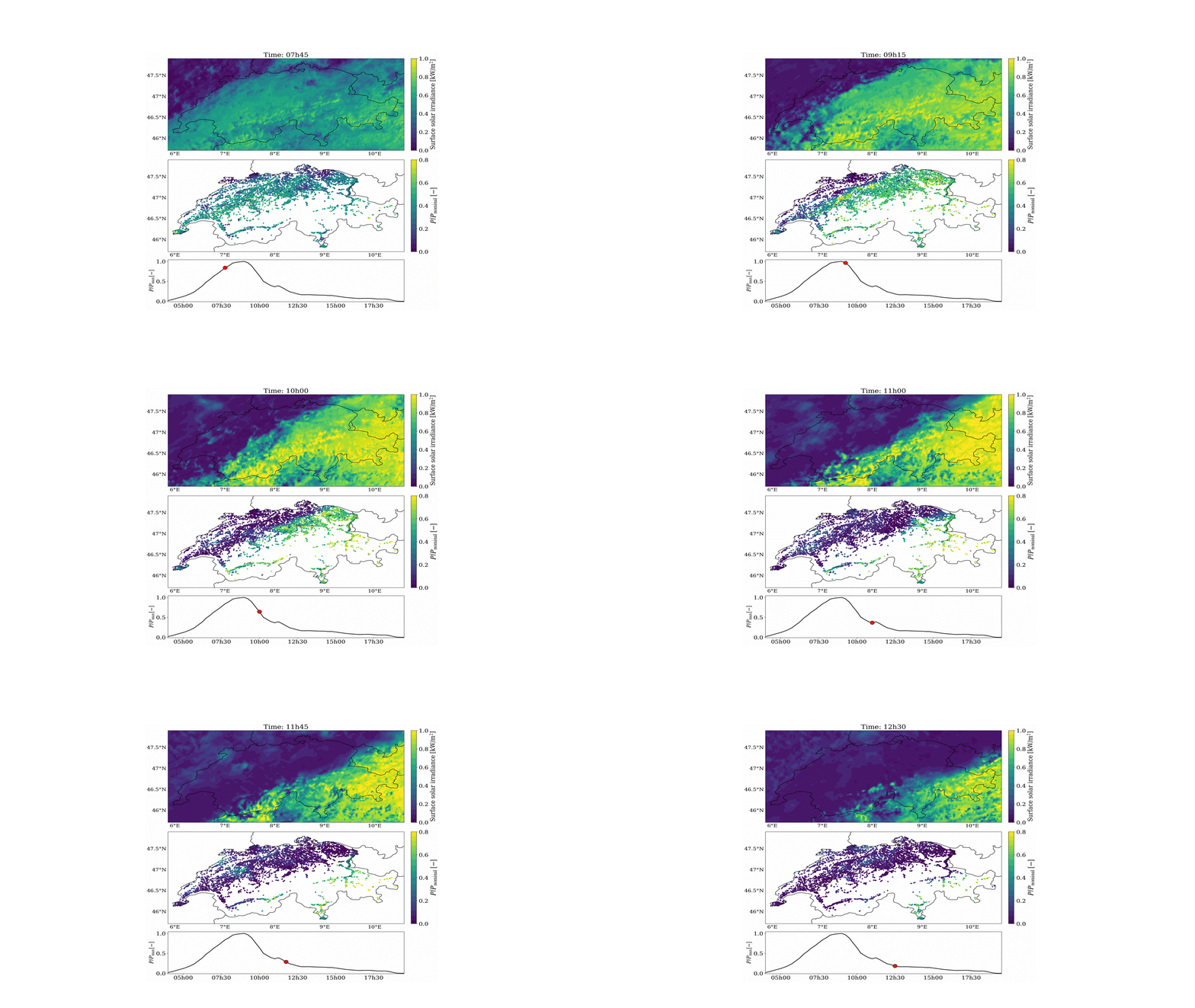
For optimising the energy grid, it’s important to know in time how much sunlight is reaching large solar farms. With a new method based on satellite images, weather models and deep learning, we can now produce spatiotemporal solar power forecasting. This research was led by L. Lanzilao from Energy Weather & AI Lab. Read more here. A crystal ball for solar energy The new method includes a prediction of appearing clouds and the amount of radiation being blocked. “Knowing befor
Jul 7


Our group at EGU 2026
Herminia presented her research on “Urban influences on cloud patterns over Europe from satellite observations” at EGU 2026. [Link] We also presented Luca's latest work on Spatiotemporal photovoltaic forecasting using satellite-based and numerical weather prediction models [Link]. Last not least, we are happy to share that Ioannis Dravilas who also presented at EGU 2026 is joining our group as a PhD student on AI-based forecasting.
May 6


AI in Weather & Energy @ EPFL AMLD
Interview on the impact machine learning is having in weather, climate, and energy meteorology research and applications. Thanks to EPFL Applied Machine Learning Days 2025!
Nov 21, 2025


New paper: Improving wind farm reliability using generative domain mapping
In our new article in Energy and AI, we address wind farm condition monitoring from a new angle, using generative domain mapping across wind turbines. In this work, led by PhD student Stefan Jonas, we show that normal behaviour models for wind turbines trained on limited data can lead to unreliable condition monitoring. To address this, we introduce a domain mapping method that improves anomaly detection and yields more accurate anomaly scores. Using a CycleGAN model, we map
Nov 18, 2025


Exchange with the Netherlands Authority for Consumers and Markets
We presented our group's research on intraday solar energy forecasting to the Netherlands Authority for Consumers and Markets (ACM). More...
Jul 4, 2025


How our research supports the energy transition
Accurate solar and wind energy forecasts can improve grid stability. Solar, wind and hydropower are key drivers in the energy transition. Electricity production from solar and wind energy is subject to significant fluctuations. These fluctuations must be mitigated through the use of storage systems and conventional power plants such as gas-fired, nuclear and coal power plants, whose output can be adjusted to meet grid demands. To ensure grid stability, the amount of electrici
Jun 25, 2025


New paper: AI-based solar radiation retrieval outperforms Heliosat
A new deep-learning satellite retrieval of surface solar radiation developed by Kevin marks a shift from traditional physics-based...
Jun 17, 2025
Ana presenting her research at EGU
Ana presented her research on “Unraveling the sources of subseasonal predictability with machine learning” at EGU. Angela gave a presentation on “Probabilistic solar radiation forecasting across Europe using deep learning”. Read more here and here .
Apr 8, 2025


Join our track at AMLD
Attend our track at AMLD - Applied Machine Learning Days on “AI to Accelerate the Energy Transition and Adapt to Climate Change” at EPFL on 12 Feb. Join us for inspiring talks and perspectives by Georges Kariniotakis, Pierre Gentine, Christian Lessig, Benedikt Blumenstiel and Alban Puech.
Feb 3, 2025


Join our lunch lecture on energy nowcasting
Learn more about our research in solar energy forecasting and wind resources for the energy transition. Join us on for this Lunch Lecture of the TU Delft Climate Action Program on November 14th. Watch the recording here .
Nov 4, 2024
bottom of page